Materials from Twelve Tales workshop: April 2026
“Your life is already artful . . .”
Warm up
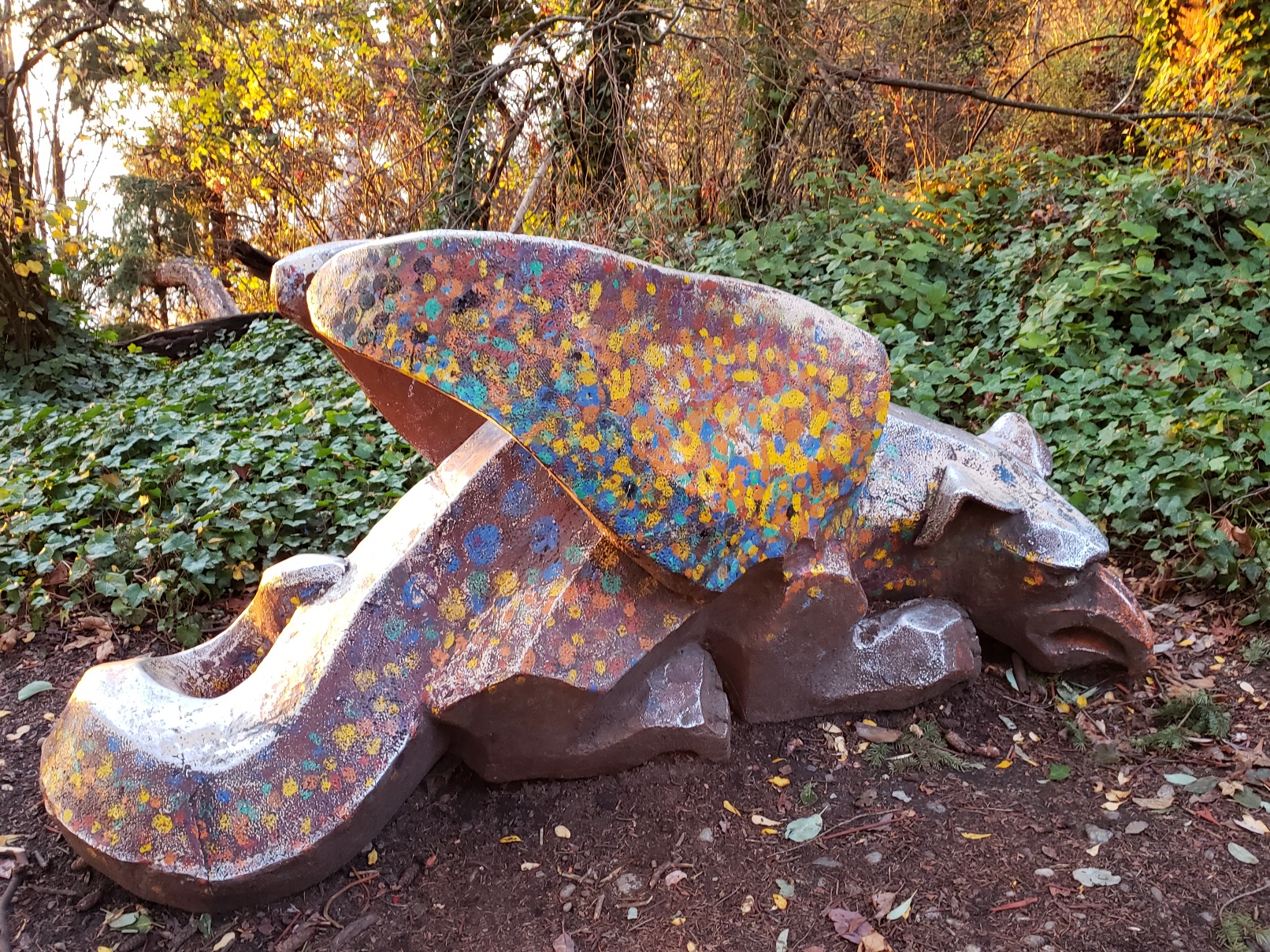
The creature pictured above lives in the forest at Lincoln Park in West Seattle, not too far from its more famous counterpart, the Troll Bruun Idun.
Colorful, metallic, and the perfect size for kids to ride, the unnamed art piece gives passers-by a chuckle, and a chance to notice how such artistry fits into our everyday lives.
Can you picture a piece of public art from your neighborhood that you know and love? What is it about your favorite piece that somehow fits into your sense of everyday artfulness?
For today’s warm up, quickly sketch and/or write about a public art piece that you see in your neighborhood. Or, invent one that you’d like to see.
Use this opening activity to loosen up, jumpstart your imagination, and get a few ideas flowing. No need to watch the clock—a bell will sound in about 5 minutes and we’ll move on to today’s discussion.
Discussion
Your life is already artful
— waiting, just waiting, for you to make it art.
~ Toni Morrison
(from 2011 Rutgers Univ. Commencement Address)
Writer Toni Morrison suggests that our everyday lives are “already artful.” Take a moment to think about what that means for you.
Examples from discussions of artfulness in everyday life:
- Gardening
- Getting kids out to school
- Waking in the morning and being aware of the way light bounces around the room
- Listening to everyone talk at dinner
- Recalling memories of other times
- Seeing individuality and nuance and expressiveness in the faces of our loved ones
- Communicating with humor and kindness—even about small, mundane things in day-to-day life (as we see in the poem “This Is Just To Say”)

Main project
Have you ever noted the creativity or beauty of daily life? Can you recall a specific time or place when an ordinary moment felt moving, meaningful, or even a little like art? Take a moment to consider how the quality of artfulness plays out in your life.
Get started telling a story that shows how “life is already artful.” Use the materials at your mini-studio, and begin in whatever way works best for you—write or sketch or use brush and ink.
Your story can be about anyone or anything—real or imagined—including yourself. And remember, this can be just a beginning instead of a finished piece.
There’s no need to watch the clock—after about 25 minutes, a bell will sound and we’ll gather for the closing activity.
DIY activity to do at home
Consider the second half of today’s quote: “Your life is already artful — waiting, just waiting, for you to make it art.”
In this phrase, Morrison calls for us to move beyond a recognition of our artfulness and actively make life into art. Simple words, but the meaning is not entirely obvious. What does the full sentence mean to you?
For a broader understanding of what Morrison leads us to consider, it’s not sufficient to look at this one sentence in isolation, as a “sound bite.” It’s better to read it in context. Below are links to two addresses in which Morrison uses the sentence. The speeches are relatively brief, yet many-layered, and definitely worth a close reading.
Read full transcripts and listen to audio recordings of Morrison’s addresses at the following links:
Multidisciplinary artist Llanor Alleyne has transcribed and posted Toni Morrison’s Commencement Address to Rutgers University Class of 2011.
The Nobel Prize Organization website contains the transcript and audio recording of the Nobel Prize Lecture delivered by Toni Morrison on December 7, 1993.
Here are a few notes to show what you’ll find when checking out the full lectures, and to help give a sense of how the context adds complexity to our topic:
➢ In a literal sense, creating one’s story means telling the tale of one’s life. “Word-work is sublime . . . because it is generative.” (1993)
➢ Creating ones story can also be understood figuratively, with a meaning akin to shaping ones life path, as in “Although you don’t have complete control of the story of your life, you can still create that story . . . you will never fully know or successfully manipulate all of the characters who surface or disrupt your plot . . . but being your own story means you can control the theme.” (2011)
➢ On language: “The vitality of language lies in its ability to limn [portray] the actual, imagined and possible lives of its speakers, readers, writers.” (1993)
➢ On language and life: Language is not a substitute for experience. Rather, language considers experience and “arcs toward the place where meaning may lie. Its force, its felicity is in its reach toward the ineffable [the unspeakable or overwhelming].” (1993)
➢ Personal expression and storytelling is a way to push back against commercializing and oppressive uses of language by others. “[Y]ou can invent the language to say who you are and how you mean in this world.” (2011)
➢ In an amazing scene in which an old woman maintains silence, her young guests say, “[T]ell us your particularized world. Make up a story. . . . We will not blame you if your reach exceeds your grasp. . . . But try. . . . Don’t tell us what to believe, what to fear. Show us belief’s wide skirt and the stitch that unravels fear’s caul. . . .” (1993)
➢ Here’s an interesting parallel structure: “From my point of view, your life is already a miracle of chance waiting for you to shape its destiny. From my point of view, your life is already artful—waiting, just waiting, for you to make it art.” (2011)
➢ Morrison says, “I am myself a storyteller, and therefore, an optimist.” (2011)
After reading Morrison, your individual sense of art and life might grow. How has thinking through her ideas added weight to your own?